Your watch should record the set you planned, not the set you tapped.
Most Apple Watch strength apps inherit a cardio data model and a sleep-wake screen that both fail the second your hands are chalked. Here is what wrist-first logging actually has to get right.
The chalked-thumb problem
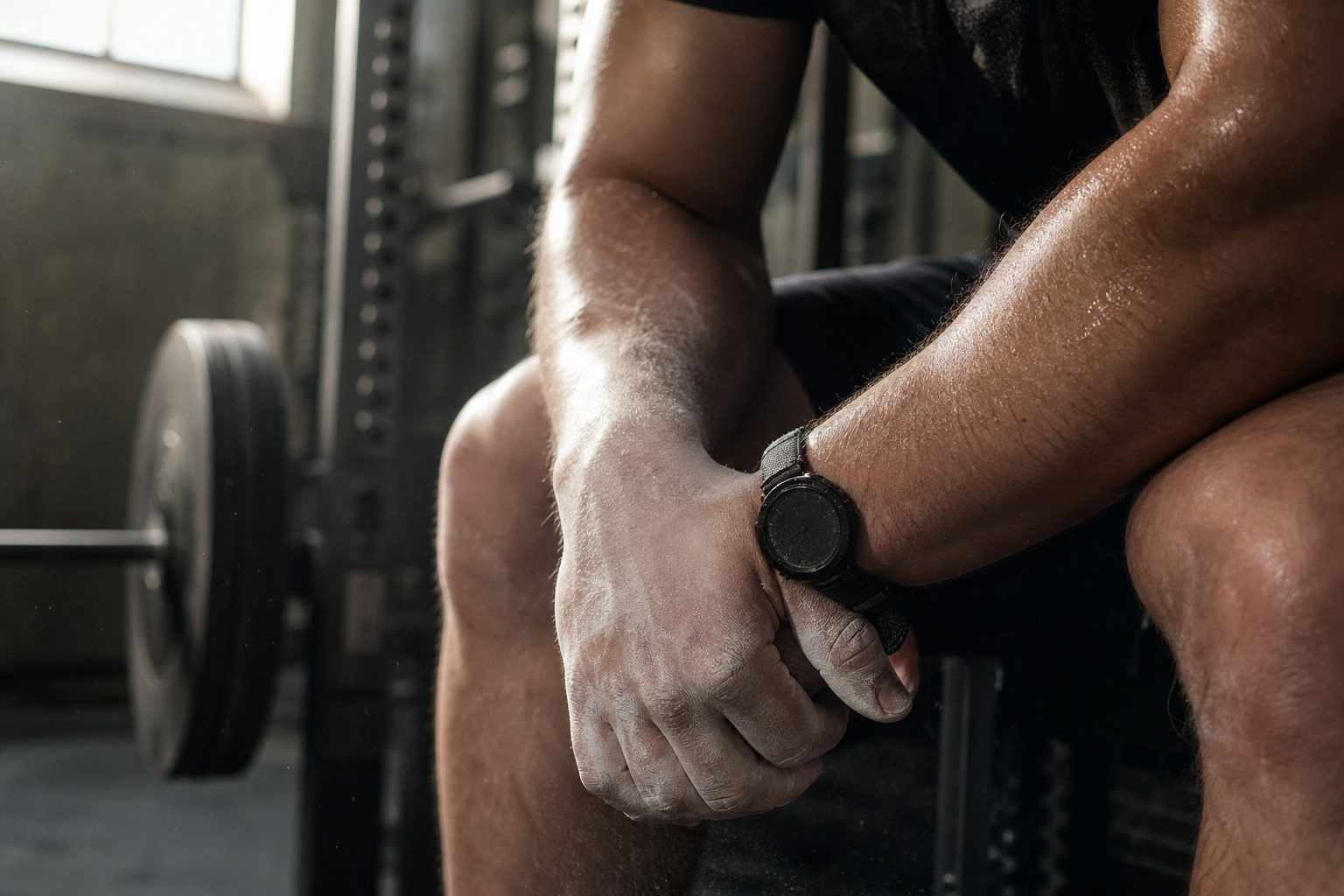
Rack the bar after a top set of five, blow the breath out, and look at your wrist to log it. The screen is black. You tap it with a thumb that still has chalk on it and nothing registers. You raise your arm, the watch wakes, but it wakes to the clock face, not to your set. By the time you have swiped back into the workout, found the rep field, and confirmed a weight you set two minutes ago, most of your rest is gone and you logged the set from memory anyway. This is the standard Apple Watch lifting experience. It is also the reason a lot of serious lifters give up on the wrist and go back to a phone propped against a water bottle.
A logbook on your wrist, not a phone on your wrist
The thesis is small and it sorts the entire category: the Apple Watch is a great surface for logging lifts, but only if the app treats it as a logbook on your wrist rather than a phone strapped to it. A logbook does not ask you to aim. It does not go to sleep between entries. It shows you the line you are on and lets you record it with the smallest possible gesture, because during a heavy set your hands are busy and your attention is on the bar, not on a 40mm touch target. Almost every watch strength app fails at exactly this point, and it fails for a reason worth naming, because once you see the reason you can see it in whichever app you are using right now.
Why the activity-ring model fights you
watchOS grew up around continuous-effort cardio. The activity rings, the workout sessions, the live heart-rate readout, all of it assumes you are moving for a sustained stretch and that the watch should be tracking that stretch in the background. Strength is the opposite shape. It is thirty seconds of work, then two to four minutes of standing around, then thirty seconds again. The data that matters is discrete: weight, reps, RPE, which set of which exercise. When an app inherits the cardio frame, it buries those four fields under a session UI built to show you a moving line, and it leans on touch input the moment your hands are the least reliable they will be all day. The framing is not malicious. It is just borrowed from a different sport, and strength logging is what gets squeezed.
The four patterns watch lifting apps fall into
Read across the App Store reviews and the r/AppleWatchFitness and r/weightroom threads on lifting from the wrist, and the same complaints converge into four patterns. First, the sleep-wake tap: the display darkens mid-rest and the only way back is a precise touch your chalked, sweaty thumb cannot land. Second, the activity-ring inheritance: sets and reps shoehorned into a session screen built for cardio, so logging a single set takes four taps and a scroll. Third, the tethered watch: the watch is only a remote for the phone in your pocket, so it stalls or desyncs the moment the phone is in a locker. Fourth, the buried timer: the rest clock you actually want lives three screens deep with no glanceable complication, so you end up timing rest on the wall clock anyway. The repository's competitive teardown documents confirm that multiple named competitors — including Strong and Fitbod — exhibit the same recurring patterns (Apple Watch sync failures, data loss complaints, subscription resentment, and locked progress graphs) documented across their App Store review corpora, with both apps independently surfacing each theme across their respective reviewer bases. Map your current app onto these and you will usually find it living in two or three of them at once.
A 5/3/1 top set, logged from the wrist
Walk one set through it. You are on a 5/3/1 bench day, top set is a planned five-plus at a known weight. With a logbook-shaped watch app, the set is already on the screen before you unrack, because the app knows your block and surfaced today's prescription. You hit the AMRAP, rack it, and the screen has not gone dark on you because the watch kept the working set in view. You record eight reps with a single confirm and an RPE bump, no aiming for a tiny field, no hunting. The rest timer is already counting on the watch face as a complication, so you glance once and know you have ninety seconds left. The phone never came out of the locker. Compare that to the chalked-thumb version from the top of this piece. Same hardware, same lifter, opposite outcome, and the only variable is whether the app was designed for the cardio frame or the logbook frame.
What changes when the wrist works
If the logbook frame is right, two things change for the serious lifter. The capture cost of a set drops to near zero, which is the whole point of wearing the watch in the first place: a log you can keep without breaking your rest is a log you will actually keep complete. And complete is what makes the history worth anything. The drift you want to catch, the week your top set stops moving, the slow creep in RPE at a fixed load, only shows up in data that did not skip the messy sessions. The watch is not a gimmick channel for strength. Done right, it is the surface that keeps the longitudinal record honest, because it removes the excuse to log from memory after the fact.
How Platepusher treats the watch
Platepusher was built watch-first for exactly this shape. The companion is capture-first: it surfaces the set you planned, takes input that survives chalk and a sweaty thumb, and keeps the rest timer one glance away as a complication rather than three screens deep. It does not repurpose an activity ring, and it is built offline-first so a phone in the locker does not stall the log. The Platepusher Apple Watch app can log sets and capture heart-rate data even when the iPhone is locked, in a bag, or out of range — it caches the last workout snapshot on the watch and queues any logged actions for automatic delivery to the phone once the connection is restored. However, the watch relies on a snapshot previously pushed by the phone, so a workout must be initiated from the iPhone before going untethered. There is no chatbot trying to motivate you and nothing nagging you between sets. The math runs on your own history, not on a guess at your wrist motion. The lifter does the lifting; the instrument records it and gets out of the way.
Be first to log lifts from your wrist the way a logbook should work.
Platepusher is built for lifters who already keep a log and already wear a watch into the rack. The watch companion is capture-first: it surfaces the set you planned, keeps the rest timer one glance away, and asks for input that survives chalk and a sweaty thumb. The record stays complete because logging never costs you your rest.