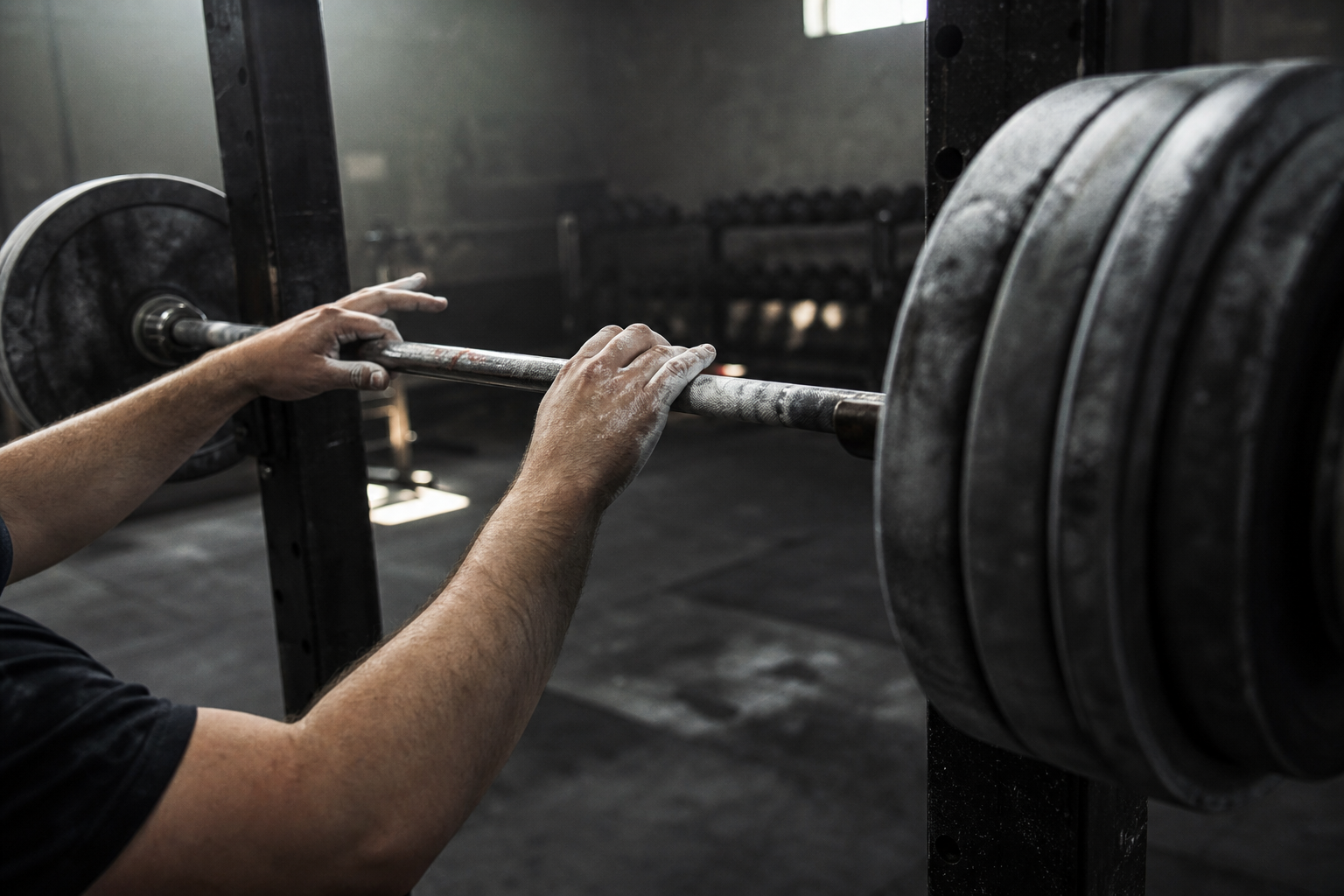
Training memory is the most fragile thing in your gym.
Every advanced lifter runs on memory: what 245 felt like last cycle, when the last deload was, which accessory finally moved the lockout. That memory is where the real signal lives, and it leaks.
The bar is loaded and you can't remember
245 sits on the bar. You loaded it because the program said 245, but standing behind it you are trying to answer a question the program cannot: did this feel like a warmup eight weeks ago, or did the last rep stall two inches off your chest?
So you strip it back to a memory. Maybe you nailed it clean. Maybe you are about to repeat a grind that told you, last cycle, that your triceps were the limiter, and you never added the close-grip work you promised yourself in the car afterward. The set happens either way. The one piece of information that would have changed today's decision stayed in a notebook you never reread, or in an app screen you swiped past.
The memory prosthesis
Here is the handle: training memory is the feature. Not the log, not the charts, not the export button. The thing an advanced lifter actually needs from a tracker is recall of the one session-relevant fact they forgot from two months ago and would use right now if it surfaced.
A notebook stores. A memory returns the right page at the right moment. Most of what serious lifters call "tracking" is really an attempt to build the second thing out of the first, by rereading old sessions before a heavy day and trusting that the relevant detail floats up. It usually doesn't. The instrument's job is to hand the fact back at the moment the fact is load-bearing, standing at the rack, not buried three taps deep in a history tab.
The set happens either way. The question is whether last cycle gets a vote.
Most trackers solve capture. Almost none solve recall.
Walk through what the popular strength trackers actually optimize. Speed of logging. Fewer taps per set. Rest timers. Reminders so you don't skip a session. Strong, Hevy, Jefit, and the spreadsheet crowd have all spent years shaving seconds off getting the number in. That is capture, and capture is basically solved.
Recall is a different problem and it is mostly unsolved. Capture asks: did you write it down? Recall asks: of everything you wrote down across two years, which single fact belongs on this screen, right now, for this exact lift? A history tab is not recall. It is a filing cabinet that makes you the search engine, at the worst possible time to be one, mid-warmup, cortisol up, trying to decide a load.
What advanced lifters actually keep in their heads
Read enough of r/weightroom or r/powerlifting and a pattern shows up: the experienced lifters do not talk about apps. They talk about their own memory of the work. What the last top set felt like. When the last real deload was, not the one the program printed. Which accessory finally moved a stubborn lockout. Whether a weight that reads the same on paper feels heavier than it did a block ago.
Those are four distinct memory surfaces, and they are exactly the four that decay fastest. The RPE-drift one is the quiet killer: "this used to feel light" is one of the most useful signals in training and one of the least reliable, because human memory launders effort. You remember the PR, not the boring grind that came before it. A tracker that remembers the boring grind for you is worth more than one that congratulates you for the PR.
Memory surface
What it recalls
Why it changes today's set
Last-time-this-rep-range
Your last 3x5 at this load, with the RPE you actually logged
Tells you whether today's target is a clean repeat or a real jump
Pre-workout context card
What you did last session for this lift and how it read
Frames the first working set before you guess the weight
Plateau-by-exercise-family flag
The week a movement pattern stopped moving, not just one lift
Catches a stall in the pattern before the third dead cycle
RPE-drift comparison
The same weight logged as an 8 last block, logged again now
Shows whether "this used to feel light" is real or nostalgia
Why RPE drift is the one to watch
Memory launders effort. You keep the clean lift and quietly delete the grind. That is why the honest read on "this feels heavier than it should" almost never comes from your head. It comes from two logged numbers, the old 8 and the new one, sitting side by side.
One bench day, walked through
You are on a 5/3/1 block, bench day, and the top set calls for 245 for as many as you can get. Without recall, you load it, take your best guess at effort, hit five, and move on. Fine session, no signal.
Now give the instrument a memory. Before you unrack, it surfaces the last time this bar sat at 245: six clean reps, logged at an 8, eight weeks ago. It flags that your bench and your close-grip work have both drifted from RPE 8 to RPE 9 at the same loads over the last three sessions, a plateau across the pressing family, not one bad day. That reframes the set entirely. Six reps today at a 9 is not progress, it is the third stalled data point, and it tells you the deload is due now, not in two weeks when the program says so. You did not compute any of that. You just read what you already knew and had forgotten.
What changes when the instrument remembers for you
If training memory is the feature, a lot of the standard tracker roadmap stops mattering. Gamification surfaces, badges, motivational nudges: none of them return a load-bearing fact at the rack. They add engagement, which is a different goal from making you a better-informed lifter.
The shift is from an app you check to an app that briefs you. You stop being the search engine over your own two years of logs. The decisions that separate a fifth-year lifter from a first-year one, when to deload, when a stall is real, whether an accessory earned its slot, all of them run on longitudinal recall. Get the recall right and the log finally does the one job you kept it for.
Where Platepusher sits
This is the frame Platepusher is built around. The surfaces in that table are not a wishlist, they are the product: last-time-this-rep-range on the working set, a pre-workout context card that shows how the lift read last session, a plateau flag that watches the exercise family rather than a single lift, and an RPE-drift read that puts the old effort next to the new one. Math, not a recommendation engine. It describes what your own logs recorded and gets out of the way.
That is also why import matters, and not as a backup story. Drop a CSV from whatever you have been using and the years you already logged become the memory the instrument reads from on day one. Your training history is the N=1 experiment you already ran on yourself. The point is to make it vote on the next session, not to archive it.
What we're watching next
The open question is how far ahead the memory should reach. Last-time recall is obviously useful. Surfacing a plateau at the exercise-family level is one step further out and harder to get right without crying wolf on a single off day. The honest read on that comes only from live logs across a real cohort of lifters running real blocks, which is the data we do not have yet and will not fabricate to fill this paragraph. When it lands, the RPE-drift threshold is the first thing worth tuning, because a plateau flag that fires early is noise and one that fires on the third dead week is a memory you already had.
Bring your logs over and let the last cycle brief the next one.
This is written for lifters with multi-year logs, the ones who already reread old sessions before a heavy day and know the relevant detail usually doesn't float up in time. Platepusher's whole design is that recall problem: it reads the history you already kept and surfaces the one fact that changes the set in front of you, deterministically, at the rack.