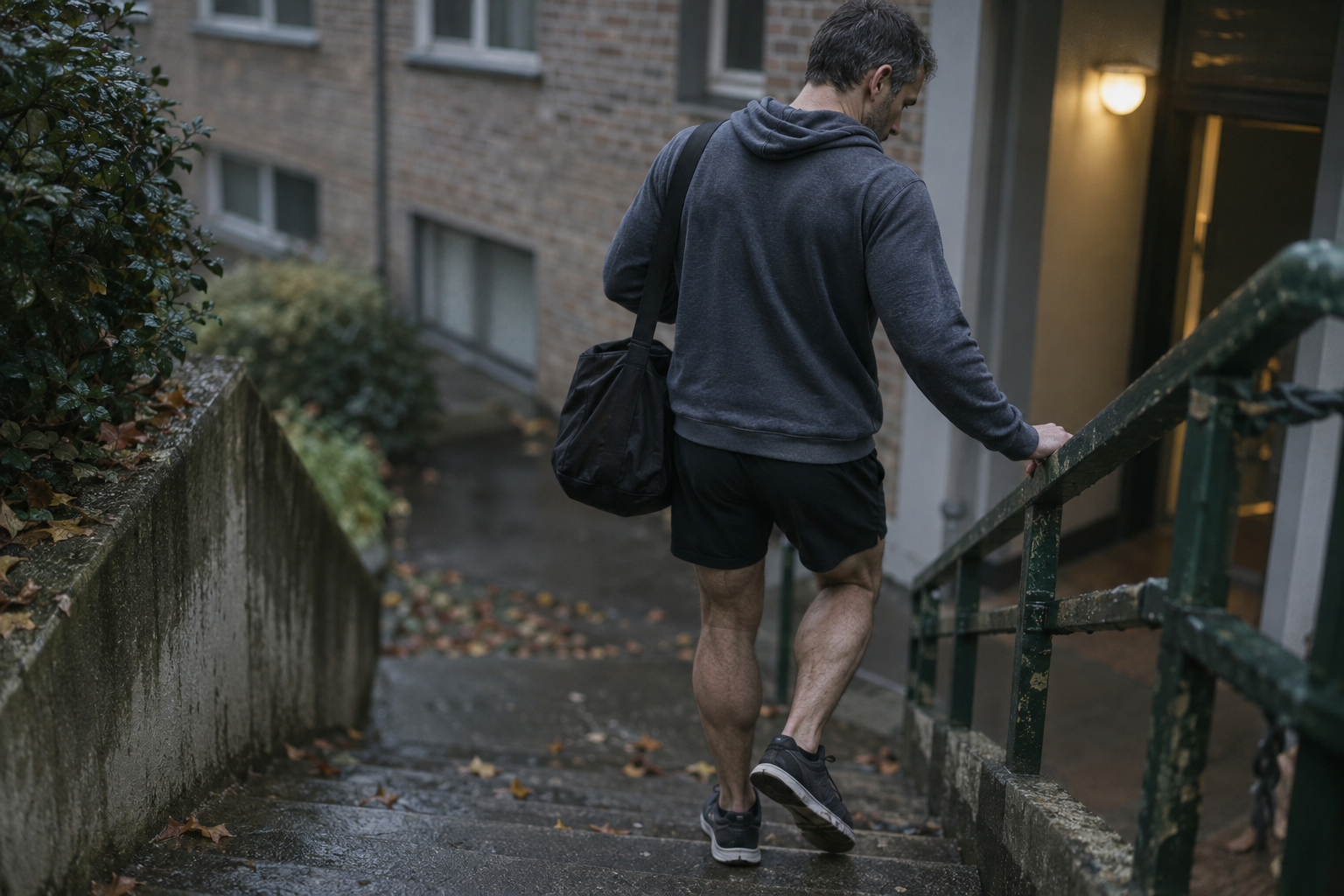
Soreness grades novelty; your log against last block grades progress.
Soreness, pump and feeling wrecked are weak grades for a session. Here's what your log can read instead, and why the best blocks tend to feel boring.
The squat day that felt like nothing
Picture two squat days in the same training block. The first ends with the lifter flat on the platform, quads buzzing, and the next two days are spent lowering onto chairs with one hand on the armrest. The second ends with five clean working sets, a back-off set that moved well, and a walk to the car that feels completely normal.
Ask most lifters which session did more and they'll point at the first one. The wreckage feels like proof.
Then open the log. The quiet day put a heavier top set on the bar than the same week last block, at the same RPE. The brutal day was a front squat variation the lifter hadn't touched in a year. One of those sessions moved the needle. The other was novelty, and the soreness was the invoice.
The quiet-block pattern
Call it the quiet-block pattern. The sessions that feel most productive are often doing the least, and the blocks that move a lifter forward tend to feel unremarkable while they're happening.
Soreness, pump and the sense of being destroyed are the three grades most lifters hand a session on the walk out. All three are loosely tied to whether anything adapted. Sometimes they point the wrong way.
A log reads three things those feelings can't. First, load and reps against the same session last block: same lift, same week of the cycle, more weight or more reps. Second, RPE at a given load against your own history at that load, because 225 at RPE 8 when it used to be RPE 9 is strength showing up before a max test would catch it. Third, volume holding while RPE stays flat, meaning back-off sets that don't creep from 7 to 8.5 across a block.
None of that is visible inside one session. Over a mesocycle it starts to show. Over several, it's obvious.
Why soreness feels like evidence (and mostly isn't)
Soreness is loud, and it shows up a day late, which makes it feel like a delayed receipt for hard work. But it mostly tracks novelty and eccentric stress. A new movement, a longer range of motion, a jump in lowering volume, a return from two weeks off: those are what make you sore.
The repeated bout effect is the catch. After a damaging session, the muscle adapts so the same work causes far less soreness next time. So soreness fades right as a program settles in and starts compounding. A lifter grading sessions by soreness will decide the program stopped working at almost exactly the moment it started.
Pump has the same problem in a different form. It feels great, it's genuinely tied to the local work you just did, and it says very little about whether this session beat the last comparable one. Leaving wrecked is the weakest grade of the three. Fatigue is a cost you paid. It isn't output.
What lifters grade by
What it mostly tracks
What the log reads instead
Next-day soreness
Novelty, eccentric load, time away from the movement
Top set against the same week last block
The pump
Local metabolic work and cell swelling in that session
Reps at a fixed load across the cycle
Feeling wrecked
Accumulated fatigue, which is a cost
Back-off volume held without RPE creep
One heroic grinder
That day's readiness and arousal
RPE at a given load against your history at that load
Session-level feelings vs. block-level log signals.
Does muscle soreness mean your workout worked?
Not reliably, and the research has said so for a while. Schoenfeld and Contreras reviewed the question in Strength and Conditioning Journal in 2013 and concluded that post-exercise soreness isn't a valid gauge of muscular adaptation. It can show up without much growth, and growth happens without much of it.
A 2016 study by Damas and colleagues in The Journal of Physiology sharpened the point. In previously untrained participants, the early rise in muscle protein synthesis was largely tied up in repairing damage. It only started lining up with the hypertrophy they eventually gained later in the program, once the damage response had faded with continued training.
That's the quiet-block pattern in lab form. The sessions that hurt most early on spend a chunk of the repair budget on cleanup. The building happens afterward, once the work has stopped feeling dramatic.
Soreness isn't useless
It carries real information in specific contexts: a new exercise, a big jump in eccentric volume, a return from a layoff, or soreness that's still there when the same muscle comes up again. It tells you something changed or that recovery is behind. What it can't tell you is whether the session was productive.
A bench block that looked boring on paper
Take a hypothetical lifter running a four-week bench wave with the same main lift and set scheme as the block before. Not one session feels like a breakthrough. There's no soreness worth mentioning. Asked about any given day, the lifter would say it was fine.
Line it up against last block, week by week, and it reads differently. Every week the top set is heavier, cheaper on RPE, or both. Week three moves five pounds more at a lower RPE. Week four adds a rep at a heavier weight than last block's grinder. And the back-off sets held their reps without RPE climbing.
Compare the lifter who chases soreness by rotating exercises every week. They're sore after nearly every session, and they have nothing to compare, because nothing repeats. Their log is a list of first attempts.
Week
Last block (top set)
This block (top set)
How it felt
1
215 lb x 6 @ RPE 8
215 lb x 6 @ RPE 7.5
Unremarkable
2
220 lb x 5 @ RPE 8.5
225 lb x 5 @ RPE 8
Unremarkable
3
225 lb x 5 @ RPE 9
230 lb x 5 @ RPE 8.5
Flat, a little tired
4
230 lb x 4 @ RPE 9.5
235 lb x 5 @ RPE 9
Fine, nothing special
Illustrative example, not study data. Same lift, same week of the wave, two consecutive blocks.
Grading the block instead of the session
If the quiet-block pattern holds, a few habits flip.
Exercise selection gets stickier. A movement you keep for a full block, or three, is a movement you can actually read. Rotating just to feel something buys soreness and spends comparability.
RPE honesty starts to matter more than any single number. RPE at a given load is only a signal when it's calibrated against your own history, and a habit of rounding up to sound tough quietly corrupts the record.
And the unremarkable session stops feeling wasted. Its job is to be comparable, so the block has something to measure against. How a day feels still has value as a readiness check. As a grade for progress, it's the wrong tool.
The best training blocks rarely feel like it while you're in them.
Reading the pattern across years, with the log you already have
Everything above depends on one thing a single session can't supply: history. That means the same lift, logged the same way, across enough blocks that a half-RPE shift or a five-pound drift actually means something.
Platepusher is built to be that record. Sets, reps, load and RPE log fast from the phone or the Apple Watch, so the record stays consistent on the days the lifter would rather not type. The plateau flag marks the week a top set stops moving, which is the other half of this story, because quiet progress and a quiet stall feel identical from inside the session. And since years of prior training import from an old tracker's CSV, the comparison doesn't start from zero.
A multi-year log is an N=1 experiment you've already been running, and the quiet blocks are where its results show up. More on that in [Your training history is the experiment](/articles/your-history-is-the-experiment).
Get Platepusher and read your next block against your last one.
Platepusher is a gym log for lifters with years of training behind them. Sets, reps, load and RPE log fast from the phone or the Apple Watch. The plateau flag marks the week a top set stops moving. Prior history imports from an old tracker's CSV, so comparing block to block starts from your real record instead of a blank screen. The free tier keeps your full history, plus CSV import and export.