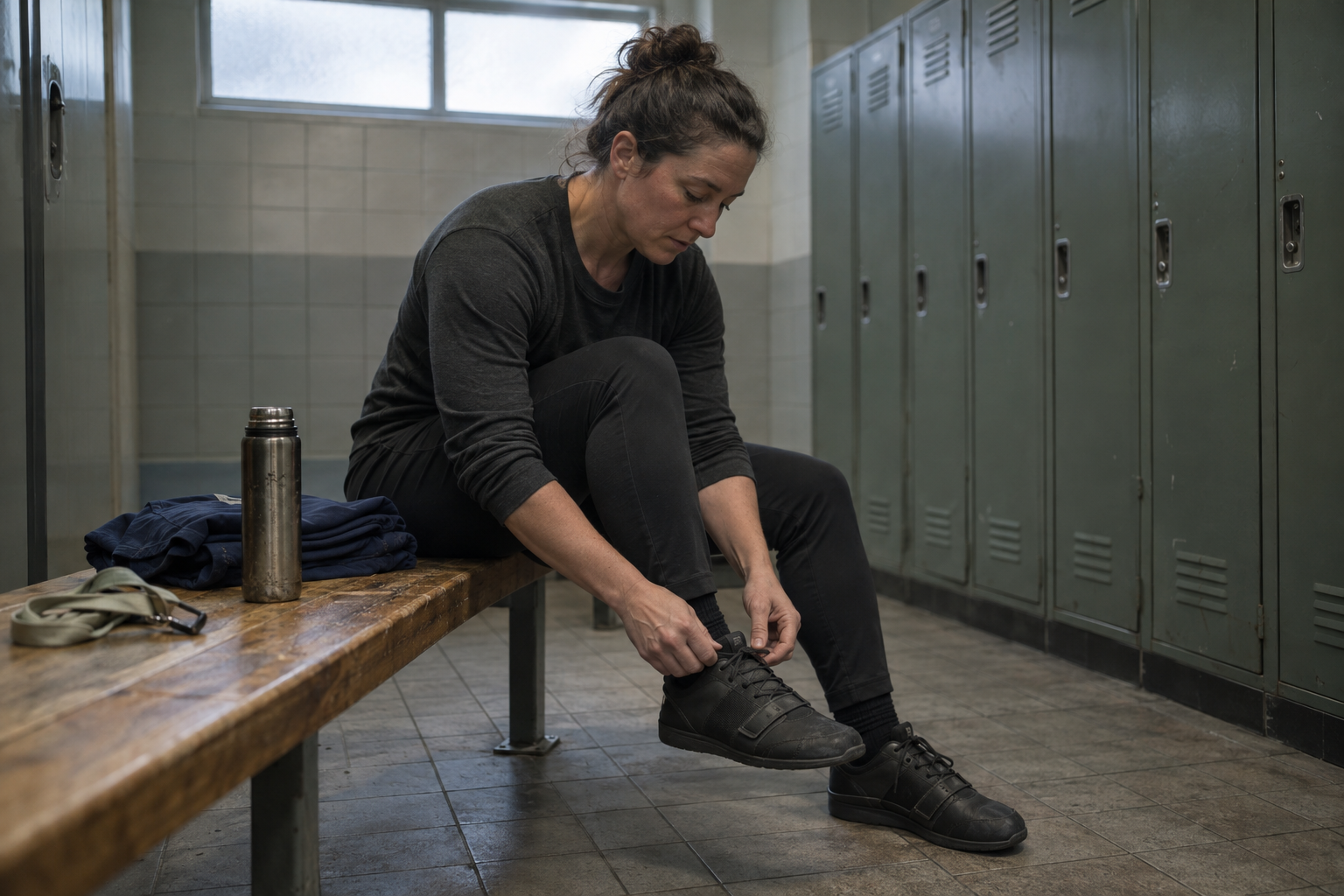
Training by feel only works when your life holds still
Training by feel worked for the golden era because their lives held still. A log is how you tell whether yours is stable enough to trust the feeling.
The squat that felt like a max
Three working sets at a weight that moved easily last month, and the first one already reads like a single at the end of a peak. The lifter racks it, shakes out their legs, and makes the call every instinct-first trainee makes: back off today, the body's telling me something.
Maybe it is. But the body sends the same message for a dozen different reasons. Accumulated fatigue from a hard block. A bad night with a sick kid. A week of eating at a desk. Or real adaptation lag, the kind that says the program has stopped working.
Instinct hears one signal. It can't tell you which one it is.
The Stability Precondition
Instinctive training works on one condition, and it's almost never stated: the lifter's life has to be stable enough that subjective readiness means something. Call it the Stability Precondition.
When sleep, food, schedule and stress hold roughly constant week to week, the main variable left moving is training itself. So when a set feels heavy, the cause is probably training-related, and the instinct to pull back or push is reading real data. Strip that stability out and the same feeling turns ambiguous.
The golden-era lifters who trained by feel weren't wrong. They got results, plenty of them. They were running a method whose precondition they happened to meet.
"It felt hard" could mean you're adapting. It could also mean you slept five hours.
Is intuitive training better than tracking workouts?
Most of what ranks for this question treats it as a personality test. Trackers are rigid, intuitive lifters are free, pick your tribe. Threads on r/naturalbodybuilding are still putting the same question to the crowd this year.
Both camps are usually describing their own circumstances accurately. The lifter with a fixed 9-to-5, no kids and a kitchen they control can train by feel for years and do fine. The lifter on rotating hospital shifts who tries the same thing is reading a gauge wired to three other engines at once.
So the useful question is narrower: which method fits the life you're actually living this block?
What the record actually shows
Instinctive training has a long history in bodybuilding. The idea is simple: you read your own feedback and let it steer the session. That only works if the reading is good, and good readings take years under the bar. It was never a beginner's method.
And the Venice Beach scene captured in Pumping Iron (1977) shows lifters whose days were organized around the gym: training partners, a fixed routine, the session as the center of the day. Whatever else was happening in those lives, the training environment was about as controlled as a lifter's gets.
Modern effort-rating research points the same way. Zourdos and colleagues' 2016 work on a reps-in-reserve RPE scale found experienced lifters rated proximity to failure more accurately than novices. Experience calibrates the gauge.
Sleep research hints at what de-calibrates it. Reilly and Piercy's 1994 sleep-restriction study found submaximal lifting performance dropped earlier than maximal strength. Partial sleep deprivation had no significant effect on maximal biceps curl performance, but it significantly affected maximal bench press and leg press. ([source](https://psycnet.apa.org/record/1994-16173-001)) That's the dangerous zone, because most working sets are submaximal. The day feels off at exactly the loads you'd use to judge readiness.
Two weeks, two readings
Take a lifter eight weeks into a hypertrophy block, incline press top set holding steady for eight reps at RPE 8. Then a new rotation at work moves them to early shifts. Sleep shrinks, and lunch becomes whatever's in the break room.
First week on the new schedule, the top set reads RPE 9. Second week, same. Instinct says the program's stalled and it's time for a deload or a new plan.
The log says something more specific. Reps held. Load held. Bodyweight dipped a little. The notes field says "early shift" on both sessions and nothing on the six before. The bar got harder because the conditions under the lift changed, and that argues for a different response: hold the load, protect sleep where possible, and don't rewrite a block that was working.
Now flip it. Same lifter, stable schedule, sleep fine, and RPE still creeps up while the top set stops moving for three weeks running. That's a training signal. Instinct and log agree, and the lifter can act on it with confidence.
What the log shows
What it usually points to
What it argues for
One heavy session, everything else normal
Noise
Train as planned next session
RPE up at the same load, reps held, notes show a sleep or schedule change
Life stress, not training stress
Hold the load; leave the block alone
RPE up and top set flat for several weeks, life stable
Accumulated fatigue or a real stall
Deload or adjust the program
RPE down at the same load across weeks
Adaptation
Progress the load
A reading guide, not a rule set. Patterns across a few weeks say far more than any single session.
Run the stability audit before you trust the feel
If the Stability Precondition holds, the choice between instinct and log isn't permanent. It changes when your life does.
A lifter coming off a stable year can lean on feel and use the log mostly as a record. A lifter with a newborn, a job change or a cut on the calendar should lean the other way: rate every top set, write one line of context, and let the pattern decide what the feeling means.
Then, when life settles, the log has done its second job. It's shown whether your effort ratings match what the bar actually did across months. That comparison is the only real evidence your instinct is calibrated.
Condition
What instinct assumes
What breaks it
What the log catches
Sleep
Roughly the same amount most nights
New baby, shift rotation, travel
RPE climbing at a fixed load while reps hold
Food
Intake steady enough that bodyweight is predictable
A cut, chaotic workdays, skipped meals
Bodyweight trend against top-set trend
Schedule
Training at a consistent time of day
Rotating shifts, early and late swaps
Session timing next to performance
Stress load
Training is the main stressor
Deadlines, illness, life events
Context notes repeating across weeks
Training age
Years of calibrated effort ratings
A layoff, a new movement, a new program
Gap between rated RPE and actual reps
Five conditions instinctive training quietly assumes. The more rows broken this block, the more weight the log should carry.
Where a gym log fits
Platepusher was built for this kind of reading. Each set records load, reps and RPE, and a notes field holds the context instinct forgets by Thursday. Plateau detection flags the week a top set stops moving, which is the signal that separates "the program has stalled" from "this week was rough."
And because your history carries forward, including the years you import from your old tracker, the calibration you built doesn't reset when you switch apps.
None of that tells you how to train. It shows whether the feeling you walked in with matches what the bar has been saying.
When instinct can be trusted
The old guard's method still works. It works best for lifters whose lives look like theirs did: steady sleep, steady food, training as the main stressor. Most lifters reading this don't live that way, at least not every block.
A log doesn't replace instinct. It tells you when your instinct can be trusted.
Start logging the context your instinct forgets.
Platepusher logs load, reps and RPE on every set, keeps a notes line for the context that changes how a session feels, and flags the week a top set stops moving. Your imported history comes with you, so years of effort ratings stay usable as a calibration record instead of starting from zero.