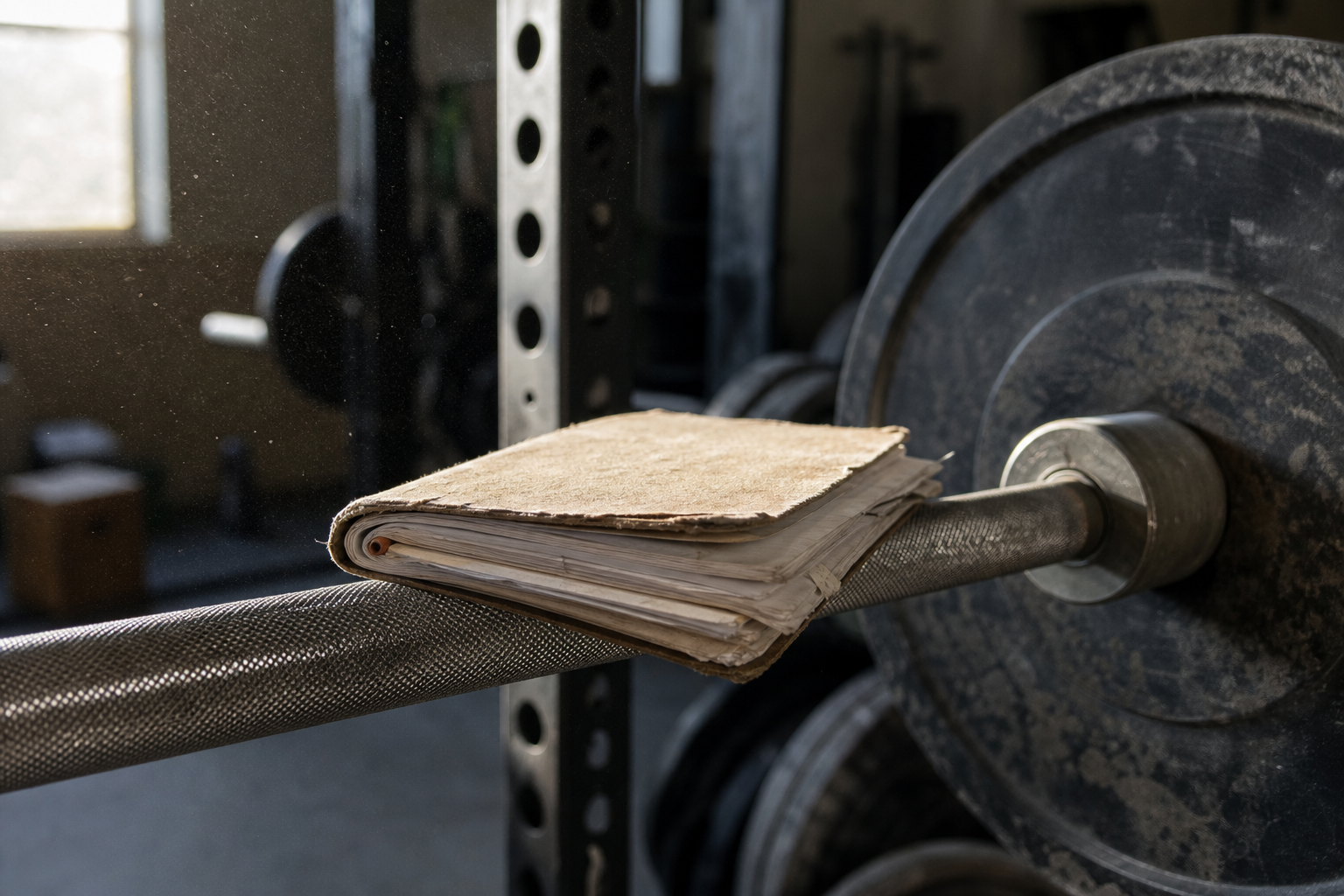
Your training log isn't a backup. It's the only study you'll run on yourself.
Most lifters keep years of logs and never read them back. Here are five things a long record actually tells you, and why the reading only works on a complete one.
You have the data. You've never read it.
Somewhere on your phone is a record of every working set you've hit for the last three years. Every top single, every back-off, the RPE you scribbled next to a 5-rep bench, the deload weeks, the block where squat went nowhere for two months. Thousands of data points.
You have opened maybe four of them. The last one, to check what you hit on incline last Tuesday so you could beat it today. That is the entire way most lifters use a log: as short-term memory, a lookup table for next session's number.
The log is not short-term memory. It is the longest study anyone will ever run on your body, and you are the only person who will ever get to read it. Almost nobody does.
The retrospective read
Call it the retrospective read: sitting down with two-plus years of your own logs and treating them as data instead of a diary. Not to feel good about how far you've come. To answer questions you cannot answer from inside a single session.
A training log is an N=1 study with one subject, one experimenter, and a sample size measured in years. Every program you ran was a condition. Every deload was an intervention. Bodyweight, sleep, life stress, they were all variables moving in the background the whole time. The session-by-session view, the one every app is built around, hides all of it. You can only see a quarter-scale trend by standing back far enough to see the quarter.
Why logging apps don't help you here
The dominant framing sells logging as capture plus backup. Get the set in fast, keep it safe, never lose it. That framing stops at the moment the set is recorded, which is exactly where the interesting part starts.
Open almost any tracker and the analysis it hands back is a chart of one lift climbing, a total-volume number, a personal-record badge. All session-scale or single-lift. None of it answers whether the deload you took in March actually did anything, or whether the program you're loyal to has quietly stalled while looking fine week to week. Those questions live at the scale of quarters and years, and the tooling was never pointed there. The record is complete. The reading is missing.
What to look for in old training logs
Five reads pull most of the signal out of a multi-year log. Each one is a question you carry to the data, not a metric the app pushes at you.
Start with the deload that paid off versus the one that didn't. Find your deloads, then look at the two weeks after each. Did the top set jump, or did it come back exactly where it left? You have run this experiment a dozen times without ever scoring it.
Then the program that looked fine and stalled anyway. Session to session the numbers moved, so it felt like progress. Plot the top set across the whole block and half the time the line is flat with noise on top.
Then the year bodyweight moved the lift more than programming did. Line up bodyweight against your main lifts. Sometimes a 'great block' was mostly eight pounds of bodyweight, and the programming was along for the ride.
Then RPE drift at a fixed load. Same weight, same reps, creeping half a point higher across a block is a readiness signal that no single session will show you.
And the lift you quit too early on, the one that was still climbing when you swapped it out for something shinier.
The read
The question it answers
Where the signal lives
Deload payoff
Did that deload actually restore anything?
The two weeks after each deload
The quiet stall
Is this program still working, or just moving?
Top set plotted across a full block
Bodyweight vs. programming
What actually moved the lift this year?
Bodyweight lined up against main lifts
RPE drift at load
Am I accumulating fatigue faster than I think?
Same weight, same reps, RPE over weeks
The lift you quit early
What was still climbing when I dropped it?
Any lift swapped out mid-progression
Walking one read all the way through
Take the deload read, concretely. You're on a 5/3/1 block, you deloaded in early March because the calendar said to, and you remember it feeling unnecessary. You felt fine. Two years of logs let you check whether 'felt fine' was true.
Pull every deload in the record. For each, note the top set on your main lift the week before and the two weeks after. One pattern: the number climbs a rep or a half-RPE-lighter after the break. That deload did work, even the ones that felt unnecessary. Another pattern: the number comes back flat, or you were already stalling before the deload and stayed stalled through it. That is a deload that fixed nothing, which usually means the problem was never fatigue.
One lifter runs this and finds their spring deloads consistently paid and their fall ones didn't, because fall was when work travel wrecked their sleep and no training deload touches a sleep problem. You cannot see that from March. You can only see it from two years up.
What changes when you read it this way
The read changes what you trust. Programs stop being articles of faith and become conditions you've already tested on yourself. You stop asking 'is this a good program' and start asking 'what did this program do to my numbers over the last block,' which is a question only your own log can answer.
The honest version of this comes with a warning. A multi-year log is confounded to the eyeballs. Sleep, stress, a new job, a shoulder that grumbled for six weeks, all of it moves your lifts and none of it is in the columns. The retrospective read is not proof of anything. It is a hypothesis generator good enough to change what you try next, and that is worth more than any generic program recommendation.
Your log is confounded, and that's fine
A multi-year record can't isolate variables. Bodyweight, sleep, stress, and injuries all moved your lifts and none of them are in the columns. Read the log to generate hypotheses, not to prove them. A trend you can see from two years up is a reason to run an experiment, not a verdict.
You cannot see it from March. You can only see it from two years up.
The read needs a whole record
The retrospective read has one hard requirement, and it's unforgiving: the record has to be continuous. A gap where you switched apps and left three months behind is a gap in the study. A year that lives in a spreadsheet, a year in one tracker, and a year in another is three short studies, none long enough to show a quarter-scale trend. RPE that you logged for a while and then stopped is a variable that goes dark right when you'd want to read it.
This is the quiet case for a single, complete, portable record. Not because losing data is scary, but because the read that makes old logs valuable only works when the record spans the years. That means importing what you already logged elsewhere so the timeline stays whole, and it means the record stays yours to take back out. A one-tap CSV export in the column shape you started with, at every tier, so the study you've been running for five years is never trapped in one app's walls. The instrument's whole job is to keep the record complete and hand it back when you ask.
Pull your history into one record and read it back. Import your past logs, keep the timeline whole, and take everything with you whenever you want.
Serious lifters end up with years of logs scattered across a spreadsheet, one tracker they quit, and another they're on now. The retrospective read needs those years in one continuous record. Platepusher imports what you already logged, keeps the timeline whole across programs, and exports the whole thing as CSV in Strong's column shape at every tier, so the study you've been running stays yours to read and yours to leave with.