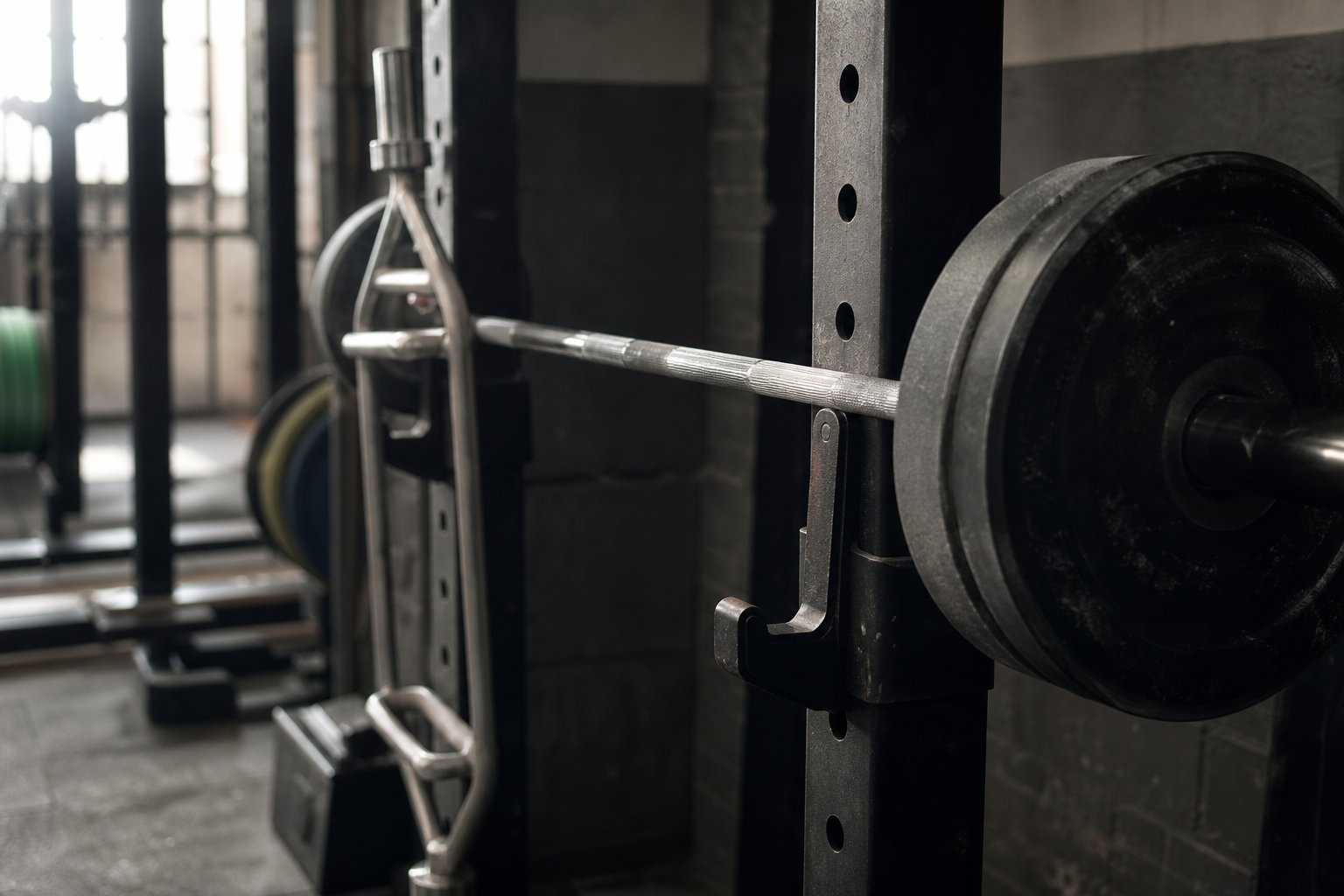
Rotate the lift without orphaning three years of progression.
Exercise rotation is a programming tool, not a data problem. But only if your log treats a paused bench and a competition bench as family instead of strangers.
Six weeks of paused bench, then the chart lies to you
You traded straight bench for paused bench for a block, chasing a stall off the chest. The paused work did its job. Your midpoint felt bolted down when you came back to touch-and-go. Then you open the bench progression chart to check where you actually are, and one of two things has happened.
Either the paused sets got dumped into the same line as your competition bench, so your chart shows a six-week nosedive that never happened (paused numbers are lower by design). Or you logged "Paused Bench Press" as its own custom exercise, and now you have two half-charts that each stop mid-story, neither one showing the arc of your actual pressing strength.
Both are wrong. The lift got better. The record got worse.
Rotation is a programming primitive. Identity is the data problem hiding under it
Rotating exercises is not a special event. It is a scheduled move you make when a stimulus goes stale, when a variation stops driving the parent lift, or when a nagging joint needs a different bar path for a while. Every serious program has rotation baked in.
The part almost no log handles is what a variation is relative to its parent. Call it the identity question: is Paused Bench the same thing as Bench, a different thing, or a member of the same family that carries its own context?
Most trackers force a binary. Same exercise, or unrelated exercise. That binary is the whole problem. The correct answer is the third option, and almost nothing models it.
The lift got better. The record got worse. That gap is a data-model failure, not a training one.
Why the custom-exercise workaround quietly breaks your history
The standard advice is to make a custom exercise. In Strong, Hevy, or Jefit you can create "Paused Bench Press" or "SSB Squat" as its own entry with its own chart. That solves the collapse problem, and it introduces a worse one.
Now your pressing strength is split across two, three, five entries, and no single view shows the trend. A safety-squat-bar block reads as a hole in your squat history instead of what it was: eight weeks of squat training under a slightly different load distribution. The progression thread, the thing that tells you whether you are actually getting stronger across a training year, gets shredded every time you rotate.
The collapse model lies about the numbers. The orphan model lies about the arc. Serious lifters end up keeping the real record in a spreadsheet, which is a quiet admission that the app never modeled the thing they came for.
Collapsed history is invisible until you need it
The damage from merging a variation into its parent lift does not show up in the moment. It shows up months later when you try to read your top-set trend and a block of lower-by-design paused or tempo work makes a real PR run look like a plateau. By then the context that would let you separate them is gone.
When a swap should share a thread, and when it shouldn't
Here is where the family model earns itself: it needs a rule for what belongs. The useful test is shared adaptation, not shared name.
Renaissance Periodization's stimulus-to-fatigue framing is the cleanest lens. Within a mesocycle you push a movement until accumulated fatigue drags its stimulus-to-fatigue ratio down, then you rotate to a variation that hits the same tissue with a fresh SFR. Paused bench, close-grip bench, and touch-and-go bench sit on the same stimulus-recovery-adaptation curve for your pressing musculature. Move enough and one drives the other. That is a family.
A barbell curl and a bench press do not share that curve. Neither, arguably, does a deep-deficit deadlift versus a block pull past a certain distance from the parent, where the Platepusher tracks each exercise variation as its own independent progression signal for charts and effectiveness scoring, no cross-variation pooling occurs there. For plateau detection only, a narrow set of mechanically-related variations on the major compound movements (squat, hinge, bench, and pull-up patterns) are treated as a shared signal pool, while everything else, accessory lifts, isolation work, anything that doesn't share the same fundamental movement name, is evaluated in isolation. The practical effect is that swapping 'Incline Bench Press' for 'Flat Bench Press' can still accumulate enough data to call a plateau, but swapping to cable flyes or a machine chest press starts a fresh data slate. shared-signal assumption stops holding. When the variation is far enough from the parent that improving it says nothing about the parent, break the thread on purpose.
Question about the swap
Collapse into one
Treat as unrelated
Exercise family
Does the top-set trend stay readable?
No, variations distort it
No, it splits in two
Yes, one progression axis
Can you filter to just competition-bench sets?
No, they're merged
Yes
Yes
Is per-variation context (pause, tempo, bar) kept?
No, it's lost
Yes, but siloed
Yes, queryable in place
Does a variation block read as a hole in history?
No
Yes
No
Do you end up in a spreadsheet?
Eventually
Eventually
No
The three identity models against the questions a lifter actually asks their log.
The SSB block, walked through
Say you run low-bar squat as your parent lift and rotate to the safety-squat bar for an eight-week block to give a cranky shoulder a break from the low-bar rack position.
Under collapse, your SSB working sets (heavier bar, different lever, usually a bit less loaded on the plates) get averaged into your low-bar line, and your squat chart shows a stall that is really just a bar change. Under orphan, "SSB Squat" becomes a brand-new chart that starts from zero, and your low-bar history flatlines for two months as if you stopped squatting.
Under the family model, both live under one Squat parent. The progression view keeps climbing on a shared estimated-strength axis. Tap the SSB block and the working-set context is right there: which bar, what the RPE ran, how the top sets moved week to week. When you rotate back to low-bar, the thread is unbroken and the SSB detour is annotated, not erased. That is the difference between a log you trust and a log you route around.
What changes when the family is the unit
If the family is the thing your log tracks, rotation stops costing you anything. You can chase a sticking point with paused work, spare a joint with a specialty bar, or swap into an incline block, and none of it fractures the record of whether you are getting stronger.
The payoff compounds over years, which is exactly the horizon a serious lifter is on. Ten mesocycles in, your pressing history is one continuous arc with the variations annotated along it, not a drawer full of disconnected charts. You can actually see which variations moved the parent and which were dead weight. That is the analysis rotation was supposed to enable in the first place, and the collapse-or-orphan binary was quietly denying you.
How Platepusher models it
Platepusher treats exercises as families. A parent lift holds its variations, and they share one progression view, an estimated-strength trend that keeps reading straight through a paused-bench block or an SSB rotation. Underneath that shared axis, every variation keeps its own working-set context: the pause, the tempo, the implement, the ROM. Filter to competition bench only when you want the raw parent-lift signal, or read the whole family when you want the arc.
The log describes what your training did. It does not average away the paused sets to keep a chart tidy, and it does not orphan them into a corner where the trend disappears. Rotate as your program calls for it. The thread holds.
The rule of thumb
Log a variation as family when improving it should move the parent lift. Log it as its own exercise when it shouldn't. Everything else is your program's business, not the app's.
What we're tracking next
The open question is where the family line falls for pulls. Deep-deficit deadlift, block pull, and rack pull share a parent but diverge in how far their strength transfers to a full-ROM pull, and lifters disagree on where a variation stops informing the competition lift. That boundary is the next thing worth pinning down with real training data rather than convention.
Bring your history over and rotate without breaking the thread.
This is the model built for lifters with multi-year logs, the ones who rotate variations every block and need the parent-lift thread to survive it. Exercise families with a shared progression view and per-variation context are the default, not a workaround you rig with custom exercises.