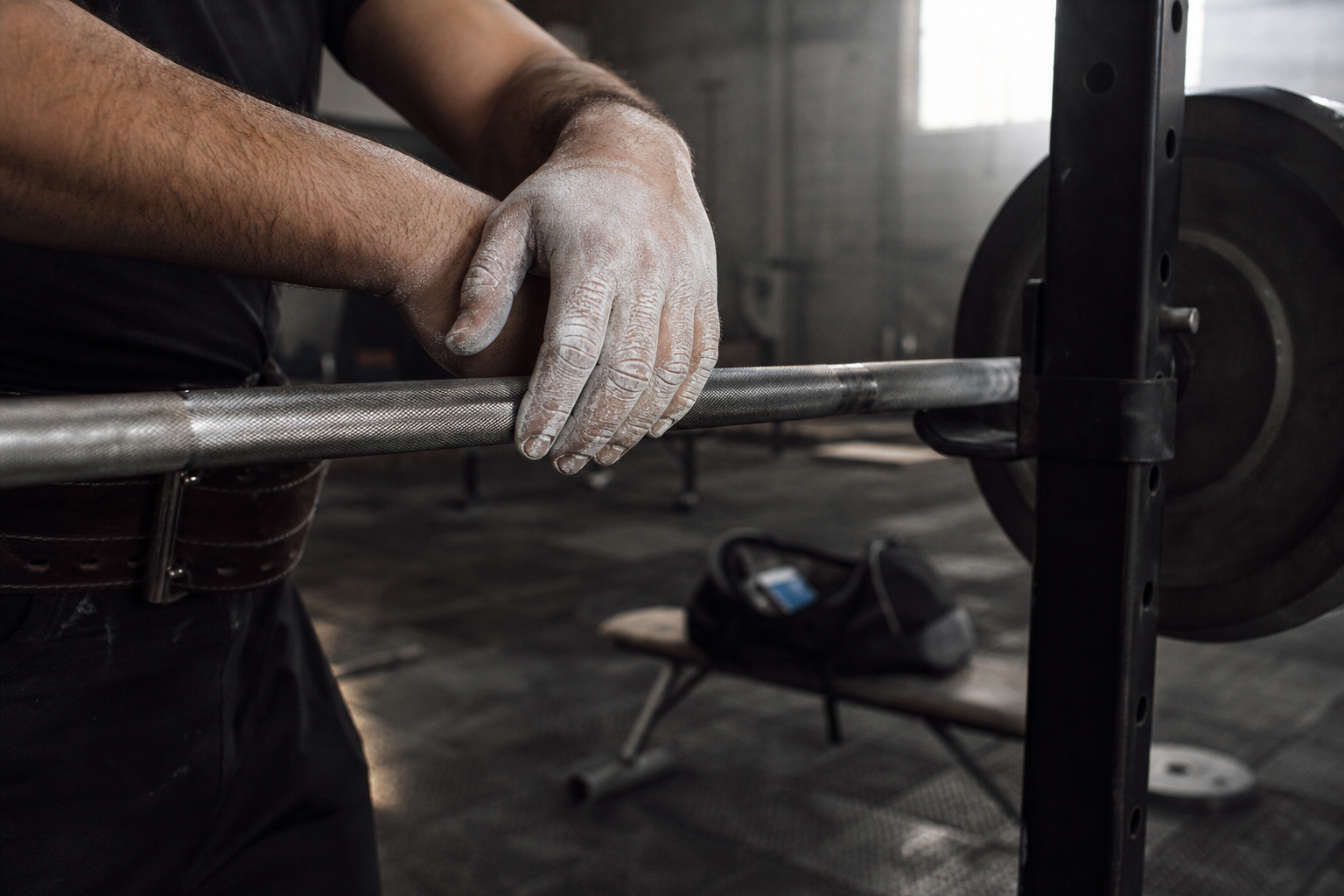
Serious lifters quit logging between sets, with chalk on their hands.
Year-five tracking attrition is a capture problem. Phone-first logging assumes free hands and a phone within reach. Trained lifters mid-session have neither.
Top set done, phone in the bag across the gym
The bar's back in the hooks. Your hands are white with chalk, your belt is still cinched, and you've got a couple of minutes before the next set. Your phone is in the gym bag by the dumbbell rack, all the way across the room.
So you make the call every serious lifter has made hundreds of times. You'll log it later.
Later means the locker room, or the car, or never. By then the top set's RPE is a guess, the back-off sets have blurred into one number, and the row set you cut short because your lower back felt off doesn't make it into the record at all.
Nobody uninstalled anything. The log just got thinner.
The between-set tax
Call it the between-set tax: the cost, paid in attention and in data quality, of recording a set inside the window between finishing it and starting the next one.
Phone-first logging charges that tax on every set. Unlock, open the app, find the exercise, find the set row, punch in load and reps, maybe RPE, pocket the phone. Each step is small. Stacked across every working set in a session, it becomes the part of training that gets skipped first.
And the tax rises with training age. A newer lifter runs fewer exercises, has more idle rest, and is genuinely curious about the numbers. A lifter in year five knows the program cold, is recovering from heavier sets, and has a stronger reason to protect focus between efforts. The input model was built for the first lifter. The second one pays for it.
At year five, the set should be logged before the rest timer runs out.
Why better features don't bring advanced lifters back
The fitness-app category mostly reads attrition as a motivation or feature gap. The fixes follow from that diagnosis: more charts, more program templates, social feeds, badges, reminder notifications. If lifters drift, give them more reasons to open the app.
But the advanced lifter already has reasons. They've run 5/3/1 or a periodized hypertrophy block, and they know exactly why last cycle's top sets matter to this one. What they're missing is a free hand and a quiet moment with a screen.
Every feature added to the phone makes capture a little worse, because it's one more thing between the lifter and the set row. A richer app is a heavier app to operate with chalk on your fingers. The category keeps answering a question the serious lifter never asked.
How advanced lifters actually talk about tracking
The complaint shows up in plain language wherever trained lifters talk shop. In r/naturalbodybuilding it gets named with no product framing at all: "it gets super annoying being on my phone." The objection is to the phone itself, and to operating it in the middle of a session.
The 3DMJ Podcast put it more bluntly on episode #46, describing tracking as something that "comes about as close to watching paint dry as it gets for advanced lifters." 3DMJ coaches natural bodybuilders and powerlifters, so this isn't a beginner's gripe about a clunky screen. It's what logging feels like once the novelty is gone and the numbers move slowly.
Read together, the two sources point at the same spot. The annoyance and the boredom both sit on capture, the act of writing the set down. Neither is a complaint about analysis. Advanced lifters still want to know what the record says. They've stopped tolerating what it costs to write it.
A heavy squat day, walked through
Take a lifter on the 5/3/1 week of a Wendler cycle. The last squat set is a plus set, as many reps as they can get, and that rep count is the most useful number of the day because it's what their estimated max gets read from.
They get the reps. Rack the bar, a few breaths, walk to the chalk bowl. The phone's in the bag. Getting to it means crossing the gym, unlocking with a chalky thumb the screen half-ignores, and scrolling to the right row. The number goes in. So does a rough RPE, maybe.
Then the supplemental sets start, and this is where the record frays. Five sets at a lighter load feel like one long set, so they get logged in a batch at the end, or just the first and last. Accessories get the same treatment. Anything cut short because a joint felt off tends not to get logged at all, and that's exactly the entry they'd want six months from now.
Nothing in that session was a failure of discipline. The input model asked for attention at the moment the lifter had the least of it to spare.
Moment in the session
What phone-first capture assumes
What's true at year five
Right after the top set
Hands are free to type
Chalk, belt, and knurling marks; glass is the last thing you want to touch
During rest
Idle time to open a menu
Rest is for breathing, plate math, and focus on the next set
Phone location
In your pocket or hand
In the bag, on a bench, or across the gym
Effort rating
Entered while the set is fresh
Guessed later, usually rounded to a whole number
Back-off and accessory sets
Logged one at a time
Batched, approximated, or skipped
Design assumptions of phone-first set entry versus a trained lifter's session. Qualitative comparison; no timing data implied.
What changes if capture is the real problem
If capture is the bottleneck, the data suffers before retention does. Lifters drift away from tracking long after their logs have gone thin, and a thin log quietly breaks the thing a multi-year history is good for: reading your own training as an experiment you've already run.
A top-set trend can survive a few missing accessory entries. A plateau read can't, and neither can a fatigue read, or a question like "what was I doing the last time my bench moved." Those need the boring sets too, and the boring sets are the first ones the between-set tax deletes.
So the design question for a tracker changes. The useful measure is how little it takes to record a set between racking the bar and starting the next one, with chalk on your hands and the phone out of reach. Capture belongs where the lifter already is, on the wrist. Review belongs where there's room to think, on the phone, after the session.
The same lens works on your own log. Scroll back three months. If your RPEs all land on whole numbers, your back-off sets match to the rep, and accessories vanish on heavy days, you're looking at the between-set tax in your own data.
Where platepusher sits in this
Platepusher splits capture and review into two jobs on purpose. The Apple Watch companion ships at every tier, free included, and the rest timer lives on the wrist, so the device already strapped on is the one tracking the gap between sets. The Platepusher Apple Watch app mirrors the active workout from the phone and lets the lifter confirm each set from the wrist: it shows the next prescribed set (exercise, weight, and reps) with a 'Complete set' button that logs the set back to the phone and automatically captures heart rate for it, plus an auto-appearing rest timer between sets; it does not let the user edit weight or reps directly on the watch, that editing happens on the phone.
The phone keeps the work that deserves a real screen: the chart, the plateau flag that notes the week a top set stops moving, and the full history, which is never paywalled. There are no streaks to punish a missed entry and no badges asking for attention between sets.
None of that makes logging exciting. The 3DMJ description will probably stay true for most advanced lifters. Tracking in year five will never be fun, and the job is to make it cheap enough that the record stays complete, because the complete record is what makes year six better than year five.
Keep the log complete in year five. Get Platepusher for iPhone and Apple Watch.
Platepusher is built for lifters with multi-year logs. The Apple Watch companion ships at every tier, including free. Full history and CSV import and export are never paywalled. The plateau flag reads your own numbers back to you, and there are no streaks, no badges, and no chatbot asking for attention between sets.